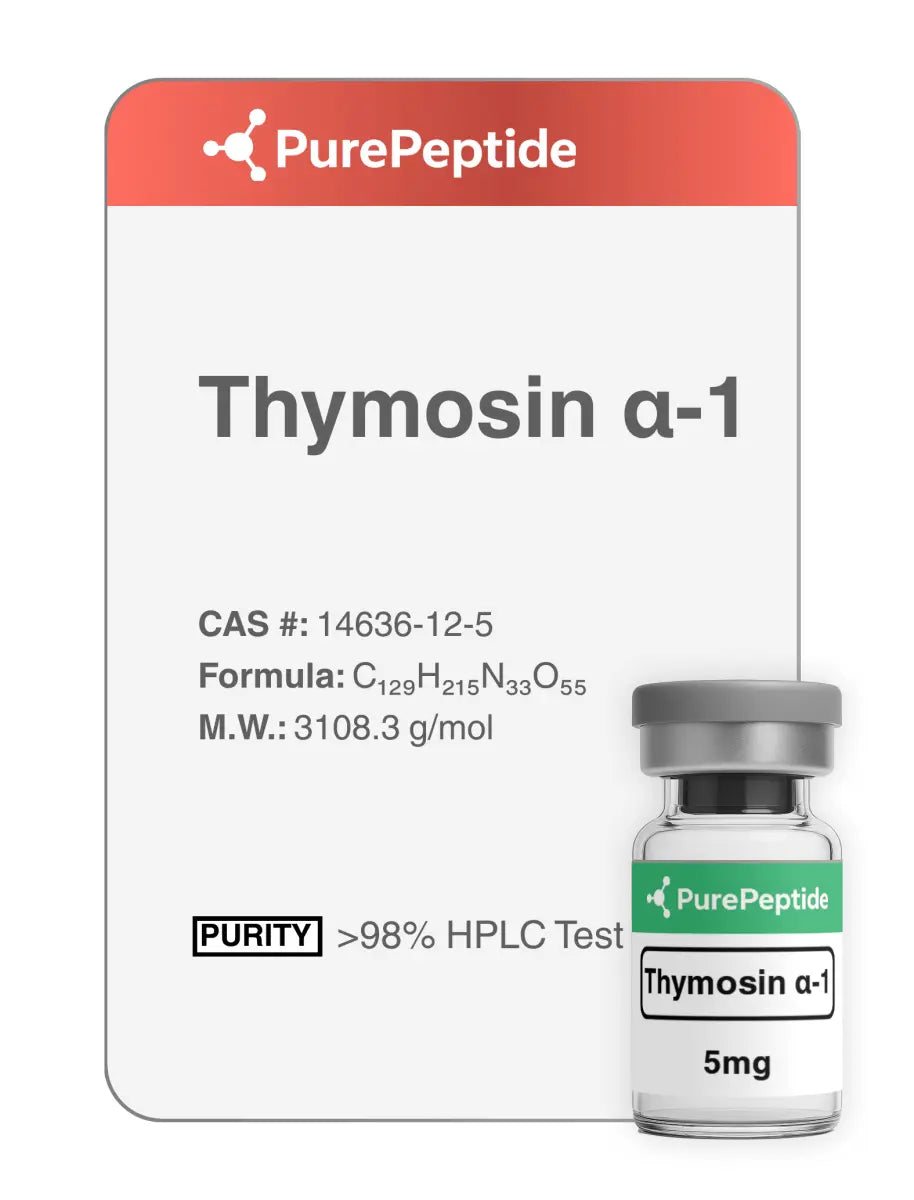
Thymosin Alpha-1 (Thymosin alpha-1) 5mg
Thymosin alpha-1 – 28-amino-acid thymic peptide, studied in relation to T-cell immunity. Price and batch analysis.
59.00 EUR · In stock
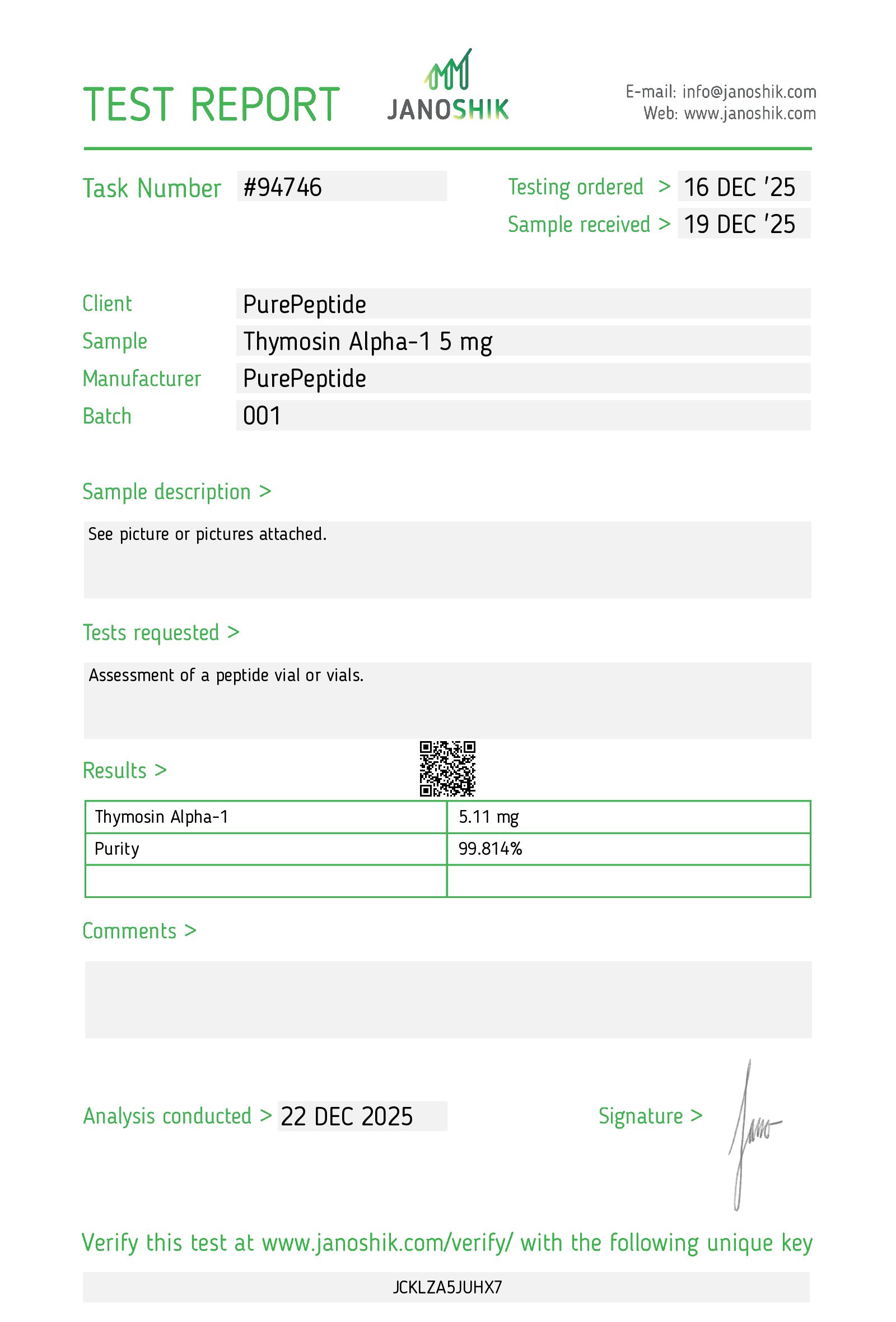
This product is intended solely for scientific and research use, as well as for use as a reference standard in HPLC analysis, and is not an approved medicinal product. It is not intended for the diagnosis, treatment or prevention of disease in humans or animals. It has not been approved by the FDA, the EMA or any national regulator. The information on this page is provided for scientific information purposes only and does not constitute medical advice, a recommendation for use, or any claim of clinical efficacy or safety.
Thymosin Alpha-1 – What the Peptide Is
Thymosin alpha-1 is a 28-amino acid peptide, originally isolated from thymus gland extract. The thymus is the organ where T-lymphocytes mature, which has determined the direction of research interest in this molecule.
Unlike thymosin beta-4, which is involved in cytoskeletal regulation, thymosin alpha-1 is associated with immune regulation. The two molecules share similar names due to their common origin from thymic extract, but they have different functions.
The compound is among the peptides in this category with the longest history of clinical research and has undergone regulatory evaluation in a number of countries for specific indications.
Mechanism of Action
The main described function is modulation of the maturation and activity of T-lymphocytes. Its influence on their differentiation and the balance between their subtypes is discussed.
An interaction with toll-like receptors, involved in pathogen recognition by innate immunity, is described. This mechanism links the molecule to both innate and adaptive immune responses.
The action is described as modulating rather than unidirectionally stimulating – a point emphasized in review publications.
Research Data and Observations
Observations track indicators of cellular immunity, including the number and activity of individual lymphocyte subtypes.
Certain lines of research examine application in conditions with suppressed immune response and in combination with other therapeutic approaches.
The data are more systematized than those for most compounds in this category, as they originate from controlled conditions.
When interpreting published data, the difference between preclinical and clinical conditions should be taken into account. Results from cell cultures and animal models describe a mechanism, but do not allow quantitative conclusions for human conditions.
The dose ranges used in preclinical studies are often not directly translatable due to differences in metabolism between species. This limitation is consistently noted in review papers.
Example Calculations
The calculations below are purely mathematical examples showing the relationship between the total amount of substance, the volume of solvent, and the resulting concentration. They do not represent a dosing recommendation, administration schedule, or instructions for use.
When dissolving 5 mg with 2 ml of bacteriostatic water:
The resulting concentration is 2.5 mg/ml, with 0.40 ml containing 1 mg of substance.
Example values:
- 0.1 ml = 0.25 mg
- 0.2 ml = 0.5 mg
- 0.3 ml = 0.75 mg
- 0.4 ml = 1 mg
- 0.5 ml = 1.25 mg
Review of Scientific Publications
The literature on thymosin alpha-1 spans more than four decades and includes both mechanistic work and controlled clinical studies.
The results pertain to the specific indications studied and are not automatically transferable to other conditions.
Safety data from studies
Described observations include reactions at the site of administration. The profile is described in the literature as relatively well tolerated within the studied ranges.
Due to the modulating nature of the action, caution is discussed in conditions with altered immune regulation.
The general limitation for compounds in this category is the absence of long-term controlled studies in humans. Available information describes mechanism and short-term observations, not a long-term safety profile.
This product is intended exclusively for research purposes. It is not a food, dietary supplement, or medicinal product and is not intended for the diagnosis, treatment, or prevention of any disease.