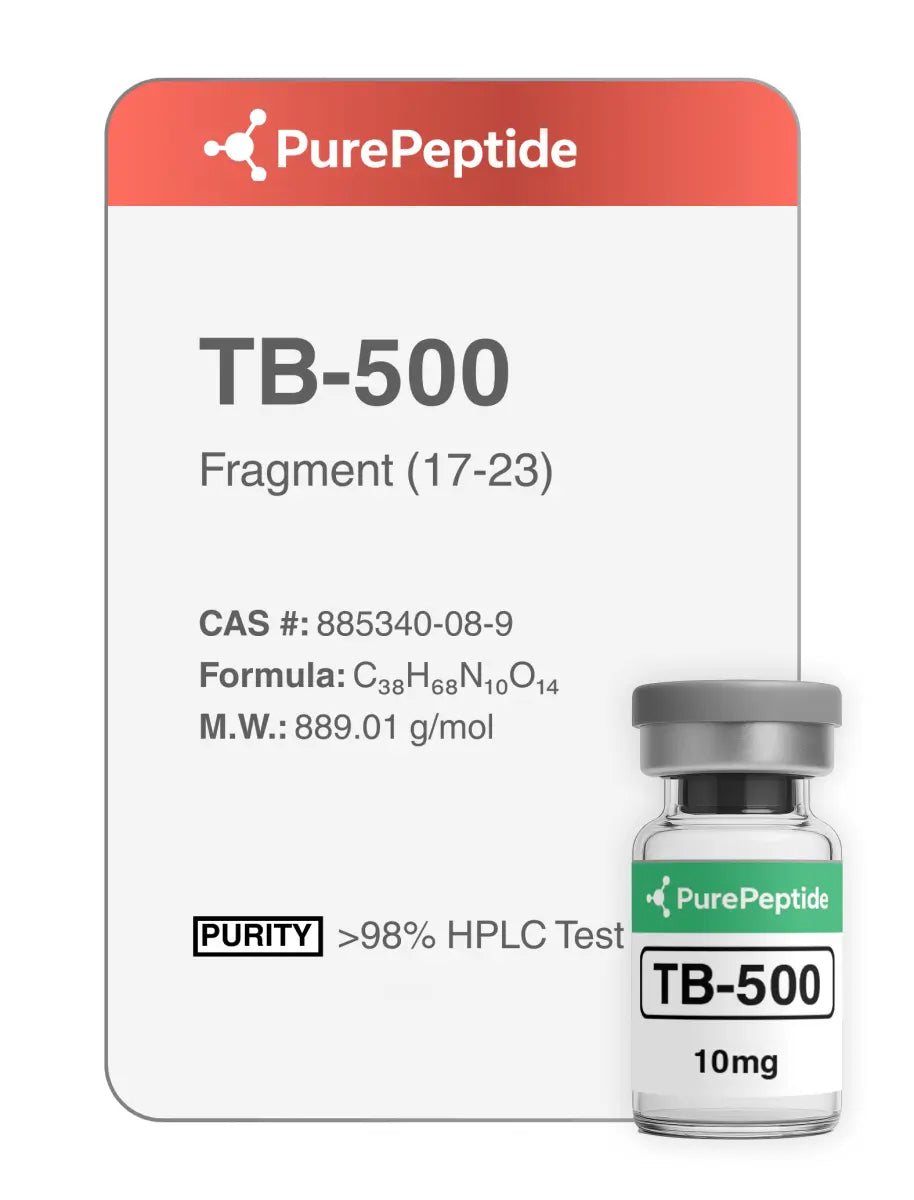
TB-500 (frag. 17-23) 10mg
TB-500 – synthetic fragment (17-23) of thymosin beta-4, studied in relation to cell migration and soft tissue. Price and batch analysis.
49.00 EUR · In stock
This product is intended solely for scientific and research use, as well as for use as a reference standard in HPLC analysis, and is not an approved medicinal product. It is not intended for the diagnosis, treatment or prevention of disease in humans or animals. It has not been approved by the FDA, the EMA or any national regulator. The information on this page is provided for scientific information purposes only and does not constitute medical advice, a recommendation for use, or any claim of clinical efficacy or safety.
TB-500 – what is the peptide
TB-500 is a synthetic peptide that reproduces the active site of thymosin beta-4 – a natural 43-amino-acid protein found in almost all human cells and in the highest concentrations in platelets and wound fluid.
The synthetic fragment covers the sequence responsible for actin binding, rather than the entire protein. This is also the reason the compound is designated as fragment 17-23 – after the position of the segment in the parent molecule.
Scientific interest in the peptide stems from the role of actin in cell motility – a property that determines the cells' ability to migrate toward a site of injury.
Mechanism of action
The central described mechanism is binding to G-actin and involvement in regulating the equilibrium between it and the polymerized F-form. This equilibrium determines the cell's ability to change shape and move.
This function also underlies the observations on endothelial cell migration, which is a prerequisite for the formation of new blood vessels. The literature also describes a link to the differentiation of cells involved in the repair process.
An influence on the inflammatory response at the site of injury is also discussed, although the data in this direction are fewer in number and more heterogeneous.
Research data and observations
Observations cover models of muscle and cardiac tissue injury, cornea, and skin. Differences in the rate of closure of wound defects compared to controls are reported.
A separate line examines concentrations of natural thymosin beta-4 in wound fluid and their relationship to the stages of recovery. These works are descriptive and do not track external application.
Translating results from animal models to human conditions remains the main limitation noted in the publications.
When interpreting published data, the difference between preclinical and clinical conditions should be taken into account. Results from cell cultures and animal models describe mechanism but do not allow quantitative conclusions for human conditions.
The dosage ranges used in preclinical studies are often not directly translatable due to differences in metabolism between species. This limitation is consistently noted in review articles.
Example calculations
The calculations below are purely mathematical examples showing the relationship between the total amount of substance, the volume of solvent, and the resulting concentration. They do not represent a dosing recommendation, an administration schedule, or instructions for use.
When dissolving 10 mg with 2 ml of bacteriostatic water:
The resulting concentration is 5 mg/ml, with 0.20 ml containing 1 mg of substance.
Example values:
- 0.1 ml = 0.5 mg
- 0.2 ml = 1 mg
- 0.3 ml = 1.5 mg
- 0.4 ml = 2 mg
- 0.5 ml = 2.5 mg
Overview of scientific publications
The literature on thymosin beta-4 as a natural protein is considerably more extensive than that on the synthetic fragment. The two groups of studies are not directly interchangeable, since the whole protein and the fragment differ in size and pharmacokinetic profile.
Review publications note that some of the properties attributed to the fragment originate from work on the whole protein.
Storage and stability
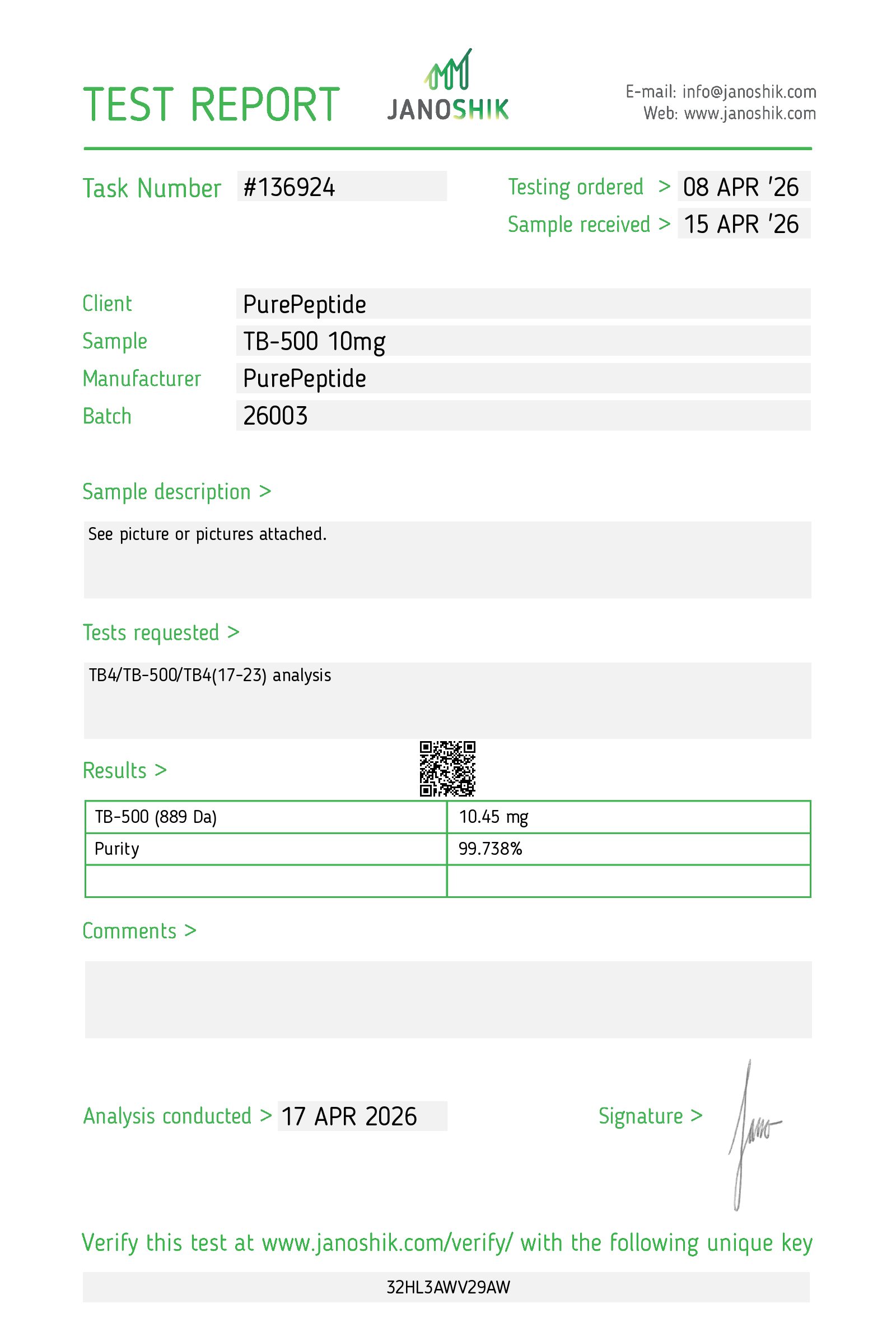
Our peptides are manufactured in compliance with strict quality and control standards. Each product is supplied in lyophilized form, which ensures stability and prevents quality degradation during transport. We test every batch.
The independent analysis report from Janoshik Analytical for the specific batch is published directly below the main product photo. The document contains the results of the identity and purity testing of the substance and can be reviewed before ordering.
Lyophilized peptides are stored in the original vial, protected from light and moisture. In this state their stability is significantly higher than after reconstitution, since the absence of water slows down the processes of hydrolysis and aggregation of the peptide chain.
After reconstitution with bacteriostatic water, the solution is stored refrigerated. Bacteriostatic water contains a preservative that limits microbial growth, unlike sterile water for injection. Repeated freezing and thawing is described in the literature as a factor that accelerates degradation of the peptide chain and leads to loss of the original purity.
Safety data from studies
Controlled data on tolerability in humans have not been published. Available observations originate from preclinical models.
The lack of long-term studies is a significant limitation in interpreting the available literature.
The general limitation for compounds of this category is the absence of long-term controlled studies in humans. The available information describes mechanism and short-term observations, not a safety profile for prolonged use.
This product is intended exclusively for research purposes. It is not a food, dietary supplement, or medicinal product, and is not intended for the diagnosis, treatment, or prevention of any disease.