PT-141 10mg
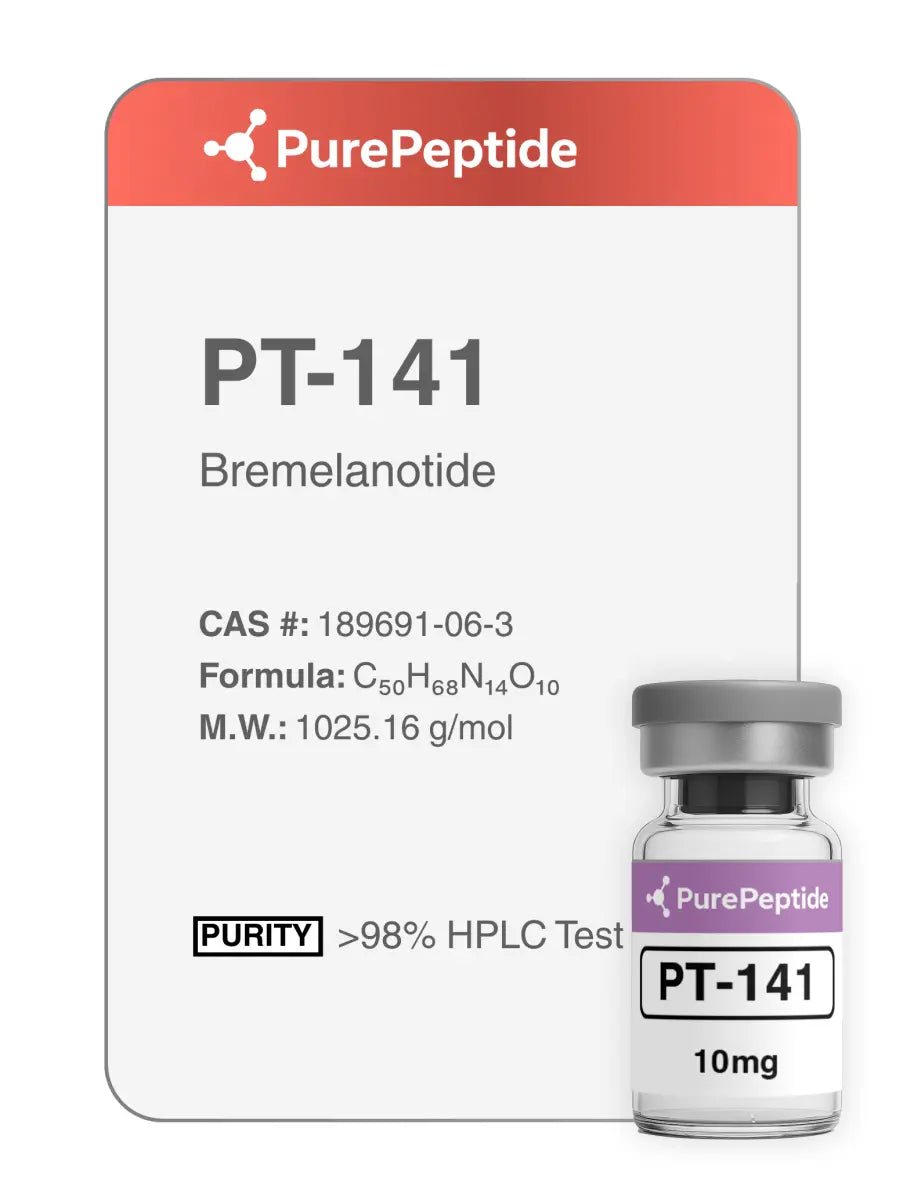
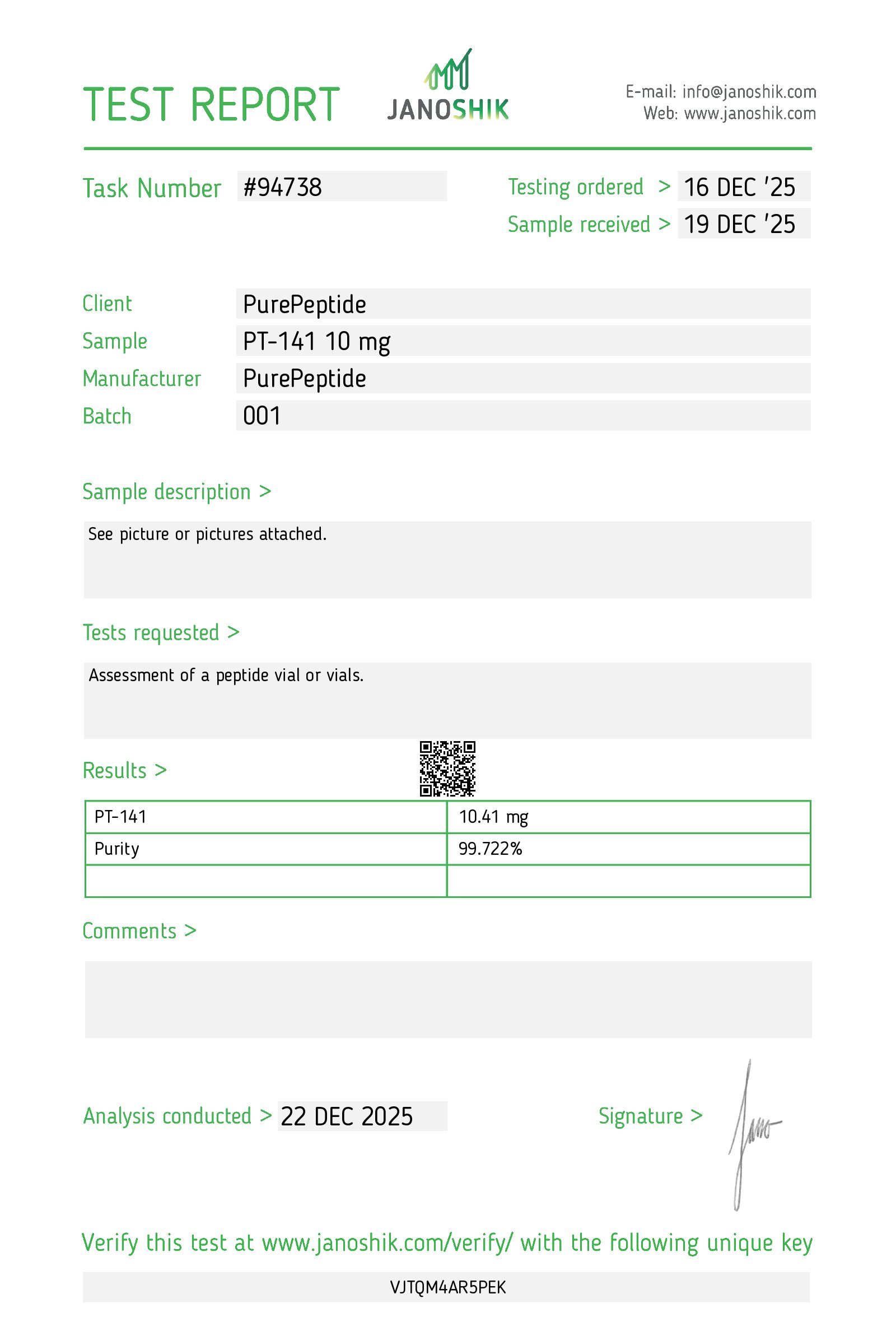
PT-141 (bremelanotide) – a melanocortin analogue acting on the MC4R receptor in the CNS, clinically studied. Price and batch analysis.
49.00 EUR · In stock
This product is intended solely for scientific and research use, as well as for use as a reference standard in HPLC analysis, and is not an approved medicinal product. It is not intended for the diagnosis, treatment or prevention of disease in humans or animals. It has not been approved by the FDA, the EMA or any national regulator. The information on this page is provided for scientific information purposes only and does not constitute medical advice, a recommendation for use, or any claim of clinical efficacy or safety.
PT-141 – What the Peptide Is
PT-141, also known as bremelanotide, is a synthetic peptide derived from Melanotan II. It belongs to the melanocortin family, but its receptor activity profile differs significantly from that of the parent molecule.
The compound was obtained during research on pigmentation analogues, in which activity unrelated to pigmentation was identified. This finding redirected research interest in another direction.
The main activity described is on the melanocortin-4 receptor, located in the central nervous system, rather than on the melanocortin-1 receptor, which is responsible for pigmentation.
The progenitor of the group is α-MSH – a hormone produced naturally by the body. Melanotan II is its more stable synthetic version. PT-141 is what remains of Melanotan II after partial degradation: a cyclic peptide of seven amino acids. This small change shifts the receptor profile – PT-141 has almost no action on MC1R (pigmentation) but retains its action on MC3R and MC4R in the brain.
Bremelanotide is the scientific name of the same molecule.
Mechanism of Action
The molecule binds to the melanocortin-4 receptor in the hypothalamus. Unlike compounds acting on the vascular system, the mechanism here is central – it begins in the brain rather than in peripheral tissues.
This difference is significant because it distinguishes the compound from phosphodiesterase inhibitors, whose action is vascular. The two mechanisms are independent of each other.
The melanocortin-4 receptor is also involved in the regulation of appetite and energy balance, which is the basis for separate lines of research on the same receptor.
In animal studies, it was tracked what happens after MC4R activation: dopamine is released in a small area of the hypothalamus (the medial preoptic area). This area is responsible for motivation, not for execution itself. Therefore, PT-141 amplifies an already existing signal rather than creating a new one – in studies without a corresponding stimulus, no effect is recorded.
Research Data and Observations
Observations focus on centrally mediated responses and were tracked using standardized questionnaires under controlled conditions.
A separate body of work examines the influence on feeding behavior arising from the role of the same receptor in energy regulation.
It is noted that the response occurs with some delay relative to administration, consistent with the central nature of the mechanism. With subcutaneous administration, the highest blood concentration is reached after about one hour, and half of the substance is degraded within about 2.7 hours. The response occurs later than the blood peak and persists after it.
Clinical studies fall into three groups: in men – intranasal and subcutaneous (Molinoff 2003, Diamond 2004); in women – intranasal (Safarinejad 2008); in women – subcutaneous, two large phase III studies (RECONNECT, 2016–2018). This is the only peptide in this category studied in both sexes.
When interpreting published data, the difference between preclinical and clinical conditions should be taken into account. Results from cell cultures and animal models describe mechanism but do not allow quantitative conclusions for human conditions.
The dose ranges used in preclinical studies are often not directly translatable due to differences in metabolism between species. This limitation is consistently noted in review papers.
Sample Calculations
The calculations below are purely mathematical examples illustrating the relationship between the total amount of substance, the volume of solvent, and the resulting concentration. They do not constitute a dosing recommendation, administration schedule, or instructions for use.
When reconstituting 10 mg with 2 ml of bacteriostatic water:
The resulting concentration is 5 mg/ml, with 0.20 ml containing 1 mg of substance.
Sample values:
- 0.1 ml = 0.5 mg
- 0.2 ml = 1 mg
- 0.3 ml = 1.5 mg
- 0.4 ml = 2 mg
- 0.5 ml = 2.5 mg
Overview of Scientific Publications
PT-141 is among the compounds in this category that have undergone controlled clinical studies, which makes the data on it more systematized than most other peptides here.
The results pertain to the specific populations and conditions studied.
The intranasal form was abandoned in 2008 because blood pressure increased in some participants. After that, all studies used a subcutaneous form at a lower dose. In phase III, a single dose of 1.75 mg subcutaneously was used. In 2019, this form was approved in the USA for one specific indication in women. We note this as a fact from the literature, not as a usage instruction.
The difference versus placebo in these studies is statistically significant but small.
Safety Data from the Studies
The most common observations are nausea, flushing, and headache. In phase III, nausea occurred in about 40% of participants – most often at the beginning, then diminishing. About 13% discontinued participation because of it. Less common: injection site reaction and nasal congestion (with the intranasal form).
Blood pressure increases transiently – systolic by about 6 mmHg, diastolic by about 3 mmHg. The peak occurs 2–4 hours after administration, normalizing by the 12th hour. This is the reason the intranasal program was discontinued.
With repeated administration, localized skin darkening has been described – on the face, gums, and breasts, more often with darker skin. This comes from residual activity on MC1R. It is dose-dependent and does not always resolve.
Described interactions: with PDE5 inhibitors (the two vascular effects add up), with alcohol (more nausea and dizziness), with blood pressure medications (unpredictable effect). PT-141 slows gastric emptying and therefore delays the absorption of substances taken orally at the same time.
The general limitation for compounds in this category is the absence of long-term controlled studies in humans. The available information describes mechanism and short-term observations, not a safety profile for prolonged use.
The product is intended exclusively for research purposes. It is not a food, food supplement, or medicinal product and is not intended for the diagnosis, treatment, or prevention of disease.