hGH frag (176-191) 5mg
hGH frag 176-191 – C-terminal fragment of growth hormone, studied in relation to lipolytic activity without raising IGF-1. Price and batch analysis.
35.00 EUR · In stock

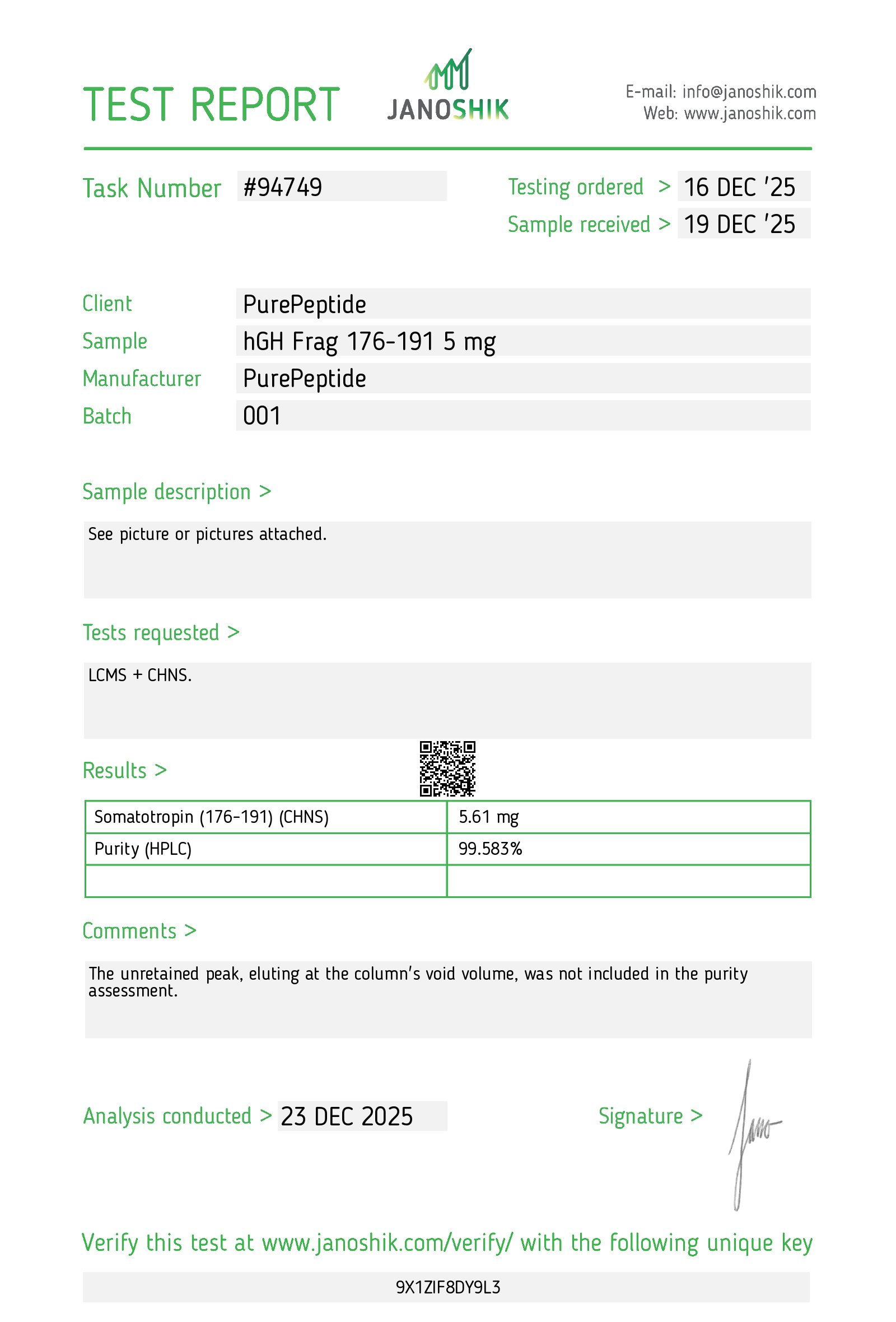
This product is intended solely for scientific and research use, as well as for use as a reference standard in HPLC analysis, and is not an approved medicinal product. It is not intended for the diagnosis, treatment or prevention of disease in humans or animals. It has not been approved by the FDA, the EMA or any national regulator. The information on this page is provided for scientific information purposes only and does not constitute medical advice, a recommendation for use, or any claim of clinical efficacy or safety.
HGH Frag 176-191 – what the peptide is
HGH Frag 176-191 is a synthetic fragment reproducing amino acids 176 to 191 from the C-terminus of human growth hormone. The complete hormone contains 191 amino acids, meaning the fragment represents only the last sixteen.
Research interest in this region stems from the observation that it retains part of the lipolytic activity of the whole hormone, without carrying its pronounced influence on growth processes.
This separation of functions – lipolytic without growth-promoting – is the reason the fragment is studied separately from the whole hormone.
Mechanism of Action
The fragment is described as acting on fat tissue breakdown processes, without significant binding to the growth hormone receptor. This means its mechanism differs from that of the whole hormone.
Effects on beta-3 adrenergic receptors in adipose tissue are discussed, with data in this direction originating mainly from animal models.
The absence of pronounced interaction with the growth hormone receptor is also the basis for not expecting an increase in IGF-1 – a significant difference compared to compounds from the growth axis.
Research Data and Observations
Observations examine changes in fat mass in preclinical models, noting the absence of accompanying increase in IGF-1.
A separate line of research tracks the influence on glucose metabolism, since the whole growth hormone has a known effect in this direction.
Data under human conditions are limited and originate from studies with a small number of participants.
When interpreting published data, the difference between preclinical and clinical conditions should be taken into account. Results from cell cultures and animal models describe a mechanism but do not allow quantitative conclusions for human conditions.
The dosage ranges used in preclinical studies are often not directly translatable due to differences in metabolism between species. This limitation is consistently noted in review papers.
Example Calculations
The calculations below are solely mathematical examples showing the relationship between the total amount of substance, the volume of solvent, and the resulting concentration. They do not represent a dosing recommendation, administration schedule, or instructions for use.
When reconstituting 5 mg with 2 ml bacteriostatic water:
The resulting concentration is 2.5 mg/ml, with 0.40 ml containing 1 mg of substance.
Example values:
- 0.1 ml = 0.25 mg
- 0.2 ml = 0.5 mg
- 0.3 ml = 0.75 mg
- 0.4 ml = 1 mg
- 0.5 ml = 1.25 mg
Overview of Scientific Publications
Literature on the fragment is significantly more limited than that on the whole growth hormone. Some of the properties attributed to it originate from studies on the whole hormone and have not been confirmed for the fragment.
Review publications note the discrepancy between interest in the compound and the volume of available data.
Safety data from studies
Reported observations include reactions at the application site. The profile is poorly documented due to the limited volume of human studies.
The absence of an increase in IGF-1 is noted as a difference compared to compounds from the growth axis.
A general limitation for compounds in this category is the absence of long-term controlled studies in humans. Available information describes a mechanism and short-term observations, not a safety profile for prolonged use.
The product is intended exclusively for research purposes. It is not a food, dietary supplement, or medicinal product and is not intended for the diagnosis, treatment, or prevention of disease.