GHK-Cu (Copper Peptide) 100mg
GHK-Cu – a copper tripeptide studied for collagen synthesis, gene expression, and tissue renewal. Lyophilized. Price and batch analysis.
39.00 EUR · In stock

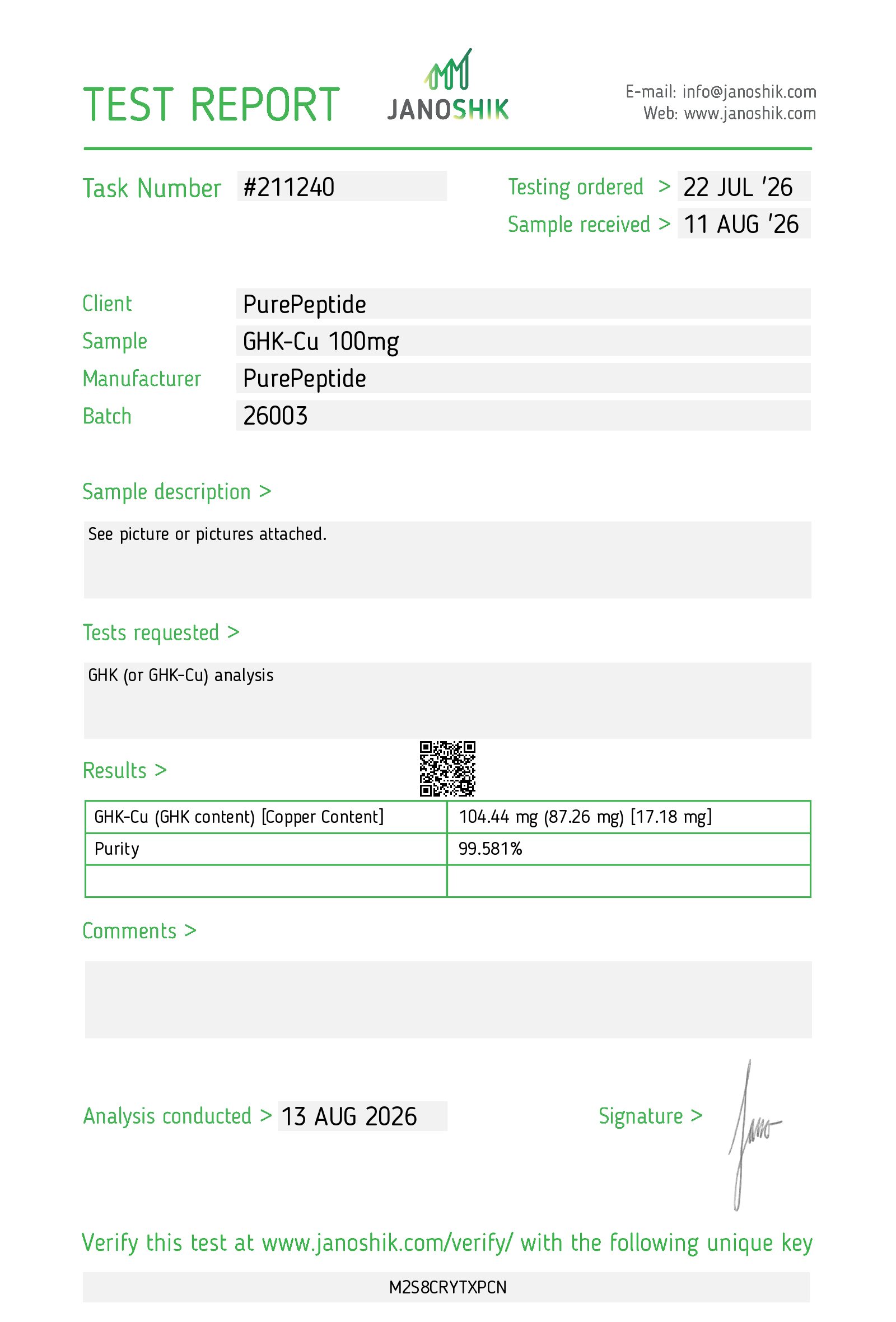
This product is intended solely for scientific and research use, as well as for use as a reference standard in HPLC analysis, and is not an approved medicinal product. It is not intended for the diagnosis, treatment or prevention of disease in humans or animals. It has not been approved by the FDA, the EMA or any national regulator. The information on this page is provided for scientific information purposes only and does not constitute medical advice, a recommendation for use, or any claim of clinical efficacy or safety.
GHK-Cu – what the peptide is
GHK-Cu is a tripeptide composed of glycine, histidine and lysine, bound to a copper ion. The natural form of the molecule has been found in human plasma, and its concentration decreases with advancing age – an observation that underlies much of the research interest.
The complex with copper is essential for the activity of the compound. The peptide sequence itself has a high affinity for copper, and the resulting complex is described as the physiological carrier of this ion between tissues.
Copper participates as a cofactor in a number of enzymatic systems, including those involved in the formation of connective tissue, which links the peptide to tissue renewal processes.
Mechanism of action
The main described function is the binding and transport of copper ions. Copper is a cofactor of lysyl oxidase – an enzyme that builds cross-links between collagen and elastin fibers and thus determines the mechanical properties of connective tissue.
A separate line of research examines the effect on gene expression. Published works describe changes in the activity of a large number of genes, including those related to the formation and degradation of the extracellular matrix.
An involvement in the regulation of antioxidant systems is also described, in which copper is a structural component of the respective enzymes.
Research data and observations
Observations include skin-repair models in which differences in defect-closure rate and in the organization of newly formed collagen compared to controls are reported.
A separate group of studies examines the effect on hair follicles and pigmentation, though these studies are fewer in number.
A significant part of the data comes from topical application on skin, which is also the most documented route in the literature.
When interpreting the published data, the difference between preclinical and clinical conditions should be taken into account. Results from cell cultures and animal models describe a mechanism but do not allow quantitative conclusions for human conditions.
The dose ranges used in preclinical studies are often not directly translatable due to differences in metabolism between species. This limitation is consistently noted in review papers.
Example calculations
The calculations below are merely mathematical examples showing the relationship between the total amount of substance, the volume of solvent, and the resulting concentration. They do not represent a dosing recommendation, administration schedule, or instructions for use.
When dissolving 100 mg with 3 ml of bacteriostatic water:
The resulting concentration is 33.3 mg/ml, with 0.03 ml containing 1 mg of substance.
Example values:
- 0.03 ml = 1 mg
- 0.06 ml = 2 mg
- 0.09 ml = 3 mg
Overview of scientific publications
GHK-Cu was described in the 1970s, and the literature on it spans over four decades, including gene-expression studies from the last decade.
Some of the publications originate from research groups associated with the cosmetics industry, which is noted in reviews as a circumstance requiring attention.
Safety data from studies
With topical application, the described observations include reactions at the application site. The profile for systemic administration is poorly documented.
Copper is an essential trace element, but also potentially toxic upon accumulation, which is noted as a consideration when discussing high concentrations.
The general limitation for compounds in this category is the absence of long-term controlled studies in humans. The available information describes mechanism and short-term observations, not a safety profile for prolonged use.
The product is intended exclusively for research purposes. It is not a food, dietary supplement, or medicinal product and is not intended for the diagnosis, treatment, or prevention of disease.