DSIP (Delta Sleep Inducing Peptide) 5mg
DSIP – a nonapeptide studied in relation to sleep regulation, stress response, and pituitary secretion. Price and batch analysis for every lot.
39.00 EUR · In stock

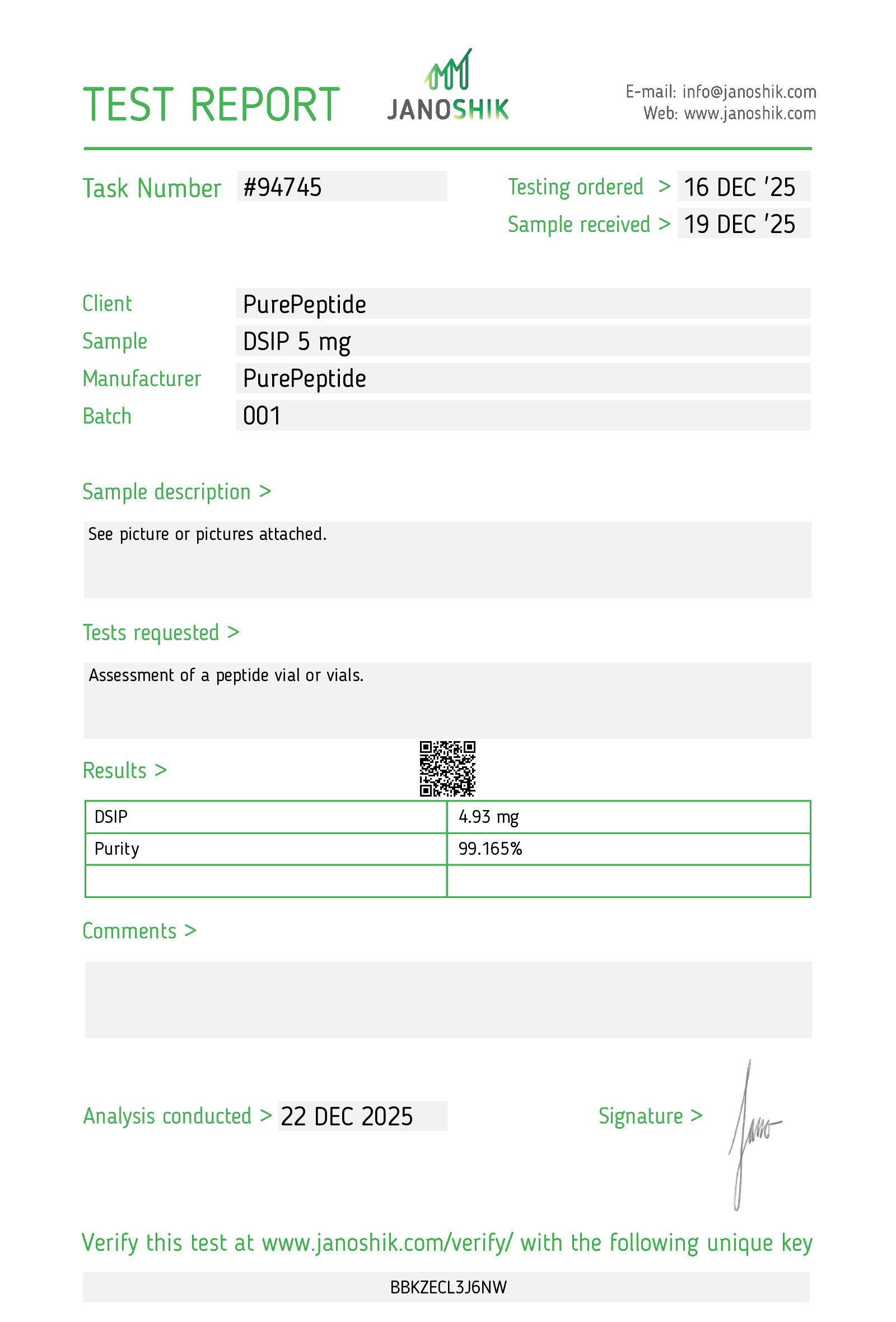
This product is intended solely for scientific and research use, as well as for use as a reference standard in HPLC analysis, and is not an approved medicinal product. It is not intended for the diagnosis, treatment or prevention of disease in humans or animals. It has not been approved by the FDA, the EMA or any national regulator. The information on this page is provided for scientific information purposes only and does not constitute medical advice, a recommendation for use, or any claim of clinical efficacy or safety.
DSIP – what the peptide is
DSIP is a nonapeptide whose name originates from the circumstances of its discovery – it was isolated from the blood of animals in a state of sleep and was designated as a Delta Sleep Inducing Peptide.
Despite its name, the molecule has been the subject of research in a considerably broader range of areas than just sleep regulation. The name reflects the historical context rather than exhausting its described properties.
The mechanism of action remains among the least clarified in this category. No specific receptor has been identified, which distinguishes the compound from most other peptides with described activity.
Mechanism of action
Unlike compounds with a clearly defined receptor, no specific binding partner has been established for DSIP. This is the main limitation in describing the mechanism and is consistently noted in review publications.
A modulating effect on several neurotransmitter systems is discussed, rather than direct activation of a specific receptor. This hypothesis remains unconfirmed.
An influence on the release of certain pituitary hormones is also described, with the data in this direction being heterogeneous.
Research data and observations
Observations on sleep are among the earliest and include tracking of electroencephalographic parameters. Results between individual studies differ substantially.
Separate lines of work examine the effect on stress response and pain sensitivity.
A significant part of the literature originates from the 1970s and 1980s and uses methodologies that are not directly comparable to modern ones.
When interpreting published data, the difference between preclinical and clinical conditions should be taken into account. Results from cell cultures and animal models describe a mechanism but do not allow quantitative conclusions for human conditions.
The dose ranges used in preclinical studies are often not directly translatable due to differences in metabolism between species. This limitation is consistently noted in review works.
Sample calculations
The calculations below are purely mathematical examples showing the relationship between the total amount of substance, the volume of solvent, and the resulting concentration. They do not represent a recommendation for dosing, an administration schedule, or instructions for use.
When dissolving 5 mg with 2 ml bacteriostatic water:
The resulting concentration is 2.5 mg/ml, with 0.40 ml containing 1 mg of substance.
Example values:
- 0.1 ml = 0.25 mg
- 0.2 ml = 0.5 mg
- 0.3 ml = 0.75 mg
- 0.4 ml = 1 mg
- 0.5 ml = 1.25 mg
Overview of scientific publications
The literature on DSIP is heterogeneous and relatively old. Modern studies are few in number, which limits the possibility of generalization.
The absence of an identified receptor remains the main gap in understanding the compound.
Safety data from the studies
Systematized tolerability data have not been published in modern literature. Older works do not describe pronounced adverse effects within the ranges studied.
The absence of a clarified mechanism limits the possibility of predicting interactions.
The general limitation for compounds in this category is the absence of long-term controlled studies in humans. The available information describes mechanism and short-term observations, not a safety profile for prolonged use.
The product is intended exclusively for research purposes. It is not a food, dietary supplement, or medicinal product and is not intended for the diagnosis, treatment, or prevention of disease.