Tesamorelin 10mg
Tesamorelin – stabilised GHRH analog, studied in relation to GH, IGF-1 and visceral adipose tissue. Price and batch analysis.
59.00 EUR · In stock
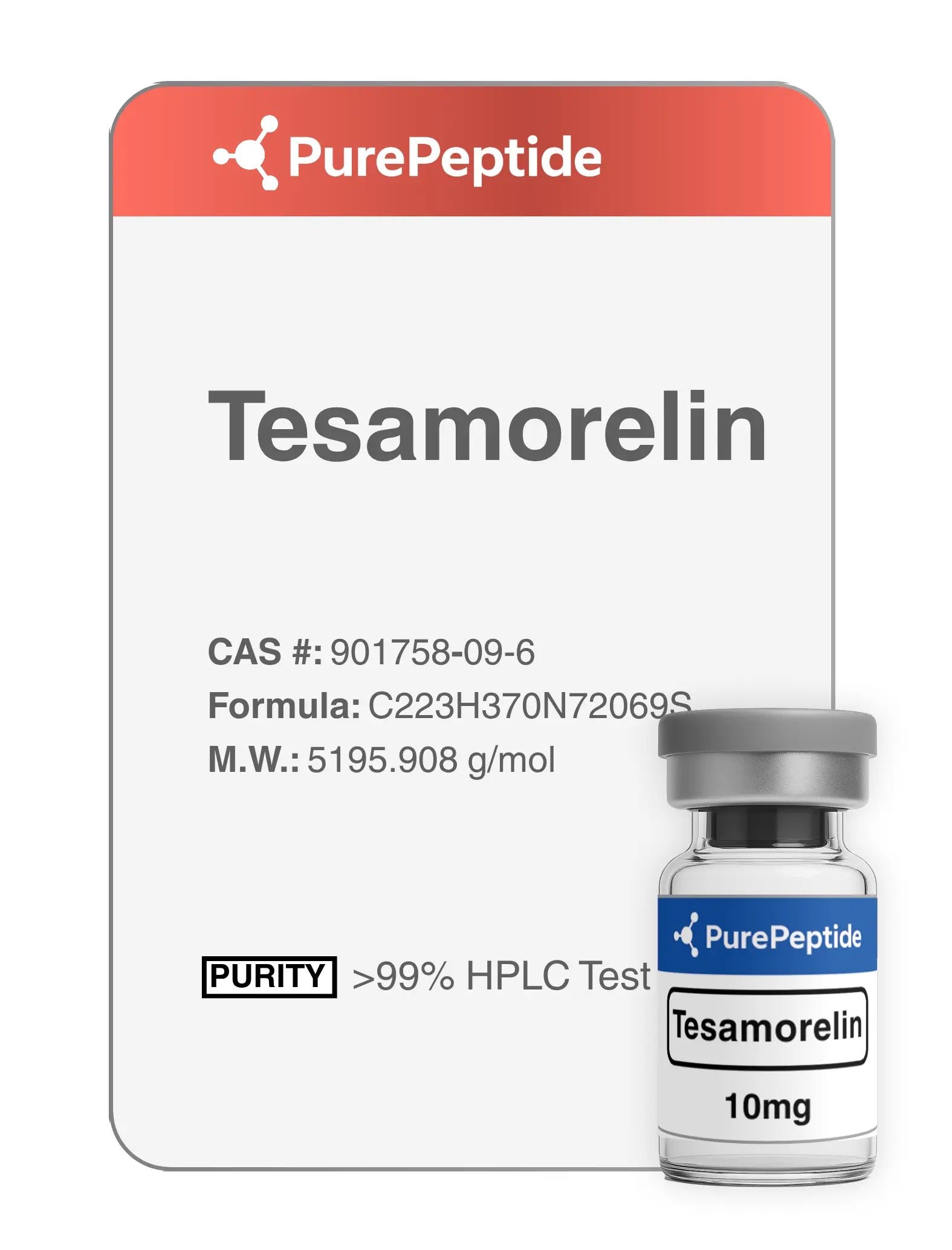
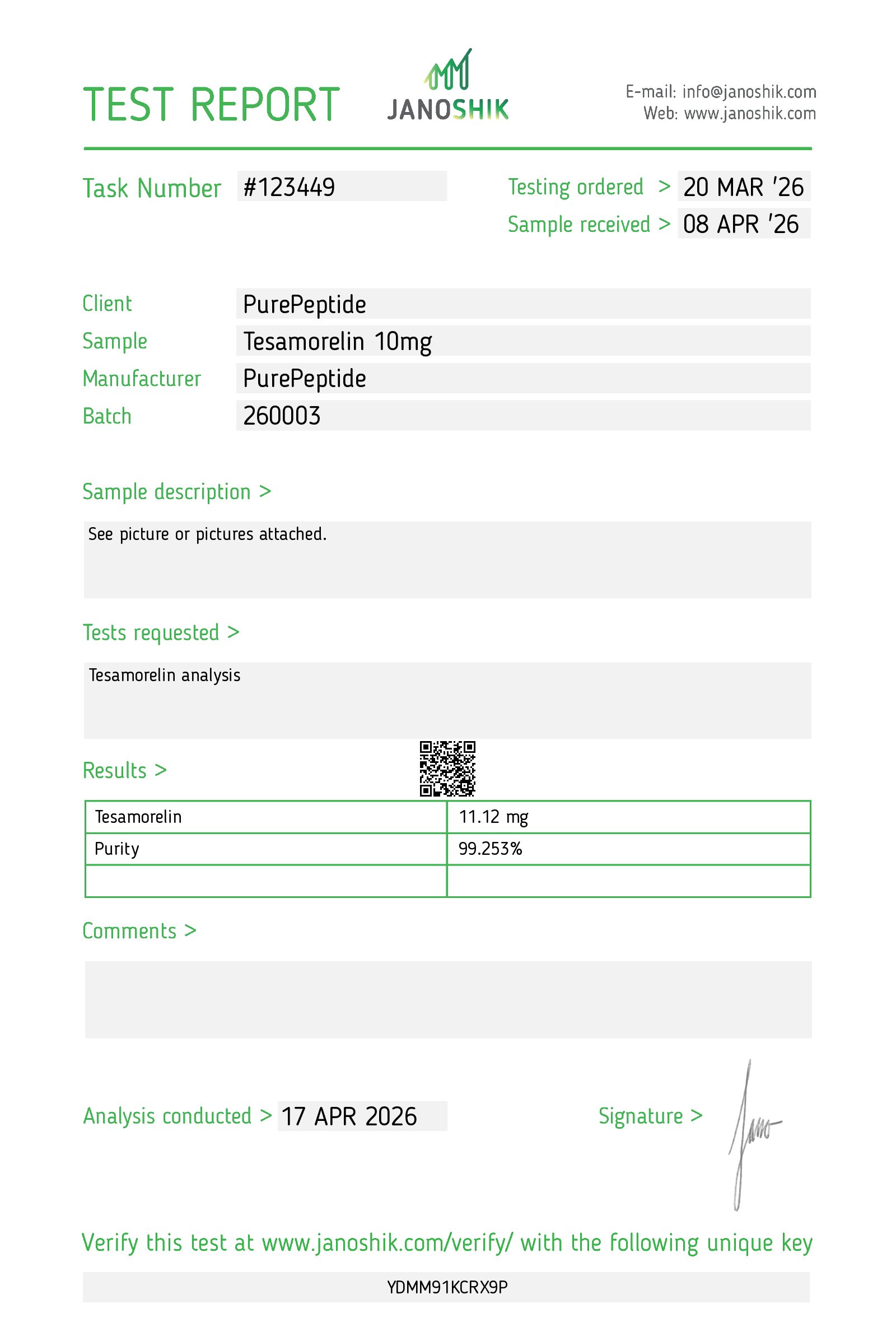
This product is intended solely for scientific and research use, as well as for use as a reference standard in HPLC analysis, and is not an approved medicinal product. It is not intended for the diagnosis, treatment or prevention of disease in humans or animals. It has not been approved by the FDA, the EMA or any national regulator. The information on this page is provided for scientific information purposes only and does not constitute medical advice, a recommendation for use, or any claim of clinical efficacy or safety.
Tesamorelin – What the Peptide Is
Tesamorelin is a stabilized analog of growth hormone-releasing hormone, built on the GHRH (1-44) sequence. A trans-3-hexenoic acid group is attached to it, whose role is to slow the enzymatic degradation of the molecule.
This modification distinguishes the compound from Sermorelin, which reproduces only the first 29 amino acids and lacks a protective group. The difference affects the stability and the duration of presence in circulation.
Tesamorelin is among the most thoroughly documented GHRH analogs, as it has undergone regulatory evaluation for a specific clinical indication, which required the collection of systematized data.
Mechanism of Action
The molecule binds to the GHRH receptor in the anterior pituitary and triggers the release of growth hormone. Release remains subject to natural regulation, including the inhibitory action of somatostatin.
The attached fatty acid group slows degradation by dipeptidyl peptidase-4 – the main inactivation pathway of natural GHRH. This also determines the longer time profile compared to unmodified analogs.
The observed increase in IGF-1 is secondary to growth hormone release and is used as an integrated indicator of the effect on the axis.
Research Data and Observations
Published observations track growth hormone and IGF-1 concentrations, as well as changes in fat tissue distribution. Different effects on visceral and subcutaneous fat tissue are noted.
Data on the compound are more systematized than those for most other peptides in this category, as they originate from controlled studies with defined endpoints.
Individual variability in response is noted, attributed to differences in pituitary reserve and baseline metabolic status.
When interpreting published data, the difference between preclinical and clinical conditions should be taken into account. Results from cell cultures and animal models describe a mechanism but do not allow quantitative conclusions for human conditions.
Dose ranges used in preclinical studies are often not directly translatable due to differences in metabolism between species. This limitation is consistently noted in review papers.
Example Calculations
The calculations below are purely mathematical examples showing the relationship between the total amount of substance, the volume of solvent, and the resulting concentration. They do not represent a dosing recommendation, administration schedule, or instructions for use.
When reconstituting 10 mg with 2 ml of bacteriostatic water:
The resulting concentration is 5 mg/ml, with 0.20 ml containing 1 mg of substance.
Example values:
- 0.1 ml = 0.5 mg
- 0.2 ml = 1 mg
- 0.3 ml = 1.5 mg
- 0.4 ml = 2 mg
- 0.5 ml = 2.5 mg
Overview of Scientific Publications
The literature on Tesamorelin includes controlled studies lasting over one year, which distinguishes it from compounds in the group documented mainly in preclinical models.
Results relate to the specific population studied and are not automatically transferable to other conditions.
Safety data from studies
Observations described in the literature include injection site reactions, edema, and joint pain associated with elevated growth hormone levels. Effects on glucose metabolism are also noted.
The profile is among the better documented in this group precisely due to the availability of controlled studies.
A general limitation for compounds in this category is the absence of long-term controlled studies in humans. The available information describes mechanism and short-term observations, not a safety profile for prolonged use.
The product is intended exclusively for research purposes. It is not a food, dietary supplement, or medicinal product, and is not intended for the diagnosis, treatment, or prevention of any disease.