MOTS-c 10mg
MOTS-c – mitochondrially encoded peptide, studied in relation to insulin sensitivity and AMPK signalling. Price and batch analysis.
45.00 EUR · In stock
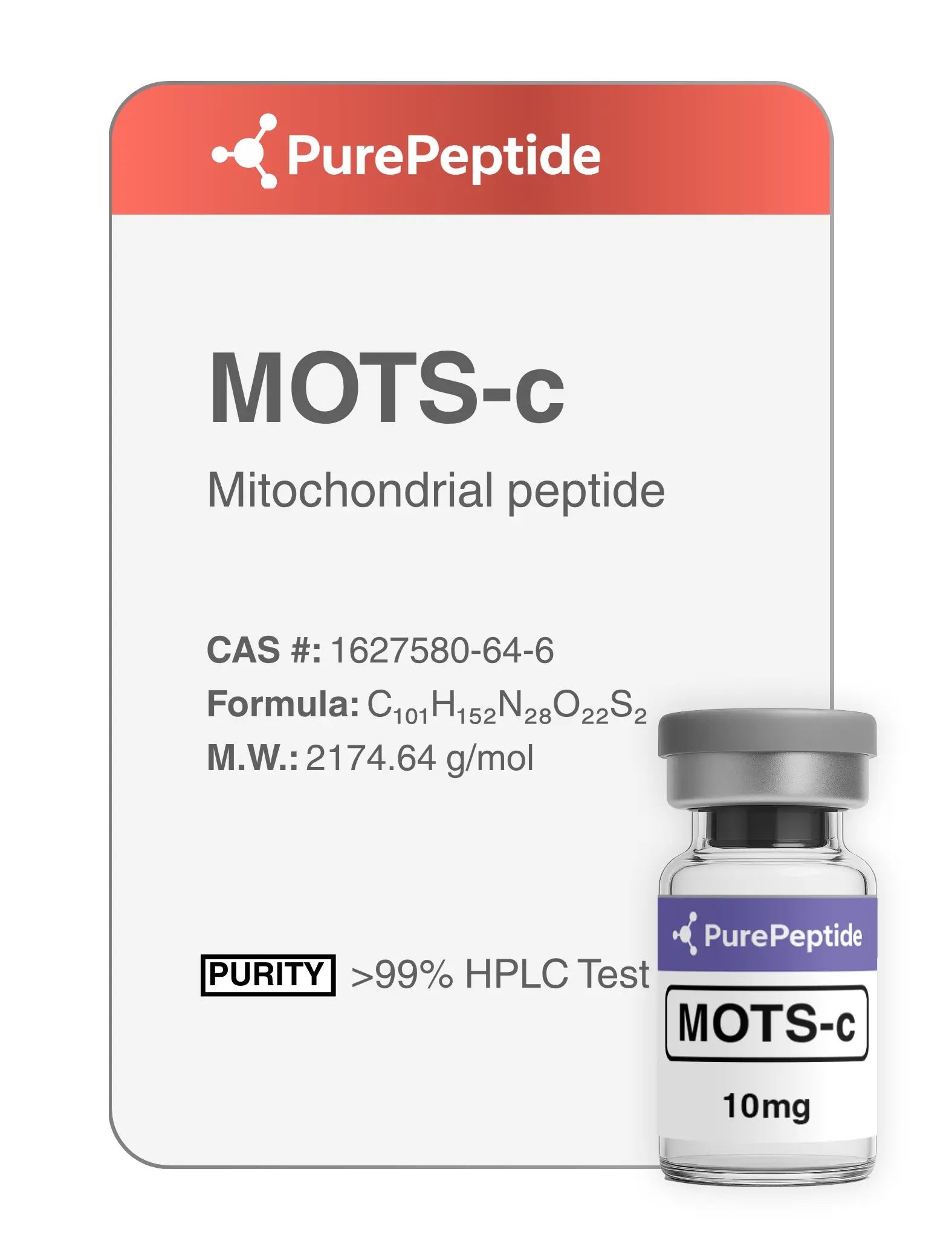

This product is intended solely for scientific and research use and is not an approved medicinal product. It is not intended for the diagnosis, treatment or prevention of disease in humans or animals. It has not been approved by the FDA, the EMA or any national regulator. The information on this page is provided for scientific information purposes only and does not constitute medical advice, a recommendation for use, or any claim of clinical efficacy or safety.
MOTS-c – what the peptide is
MOTS-c is a peptide of 16 amino acids, encoded not in nuclear but in mitochondrial DNA. It belongs to the relatively newly described group of mitochondrial-derived peptides, whose discovery changed the view that mitochondria perform solely an energy-producing function.
The molecule is regarded as a signaling one – it is hypothesized to carry information from the mitochondrion to the nucleus and to participate in regulatory mechanisms related to cellular metabolism. This type of communication is referred to in the literature as retrograde mitochondrial signaling.
Scientific interest in the compound is directed toward its relationship with insulin sensitivity, glucose utilization, and metabolic adaptation under physiological stress.
Mechanism of action
The peptide is associated with the activation of adenosine monophosphate-activated protein kinase (AMPK) – an enzyme that functions as a sensor of the cell's energy status. When the ATP-to-AMP ratio is reduced, AMPK is activated and switches metabolism toward energy-producing pathways.
Translocation of the peptide to the cell nucleus under metabolic stress has also been described, where it is hypothesized to participate in the regulation of gene expression. This mechanism is the basis for regarding MOTS-c as a signaling molecule rather than merely a metabolic product.
Research data and observations
Published observations examine the peptide's influence on metabolic pathways related to glucose uptake, including those engaged during muscular exertion. Part of the research focuses on the enzyme AMPK and its role in energy homeostasis.
A separate line of work tracks endogenous peptide concentrations and their relationship to age and metabolic status. These observations are predominantly associative and do not establish a causal relationship.
A large part of the available data originates from cellular and animal models. Translating them to human conditions remains an open question in the literature.
Some works examine the relationship between the peptide and physical exertion, noting changes in its concentrations after exercise. The direction of this relationship – whether exertion raises levels, or whether raised levels facilitate adaptation – remains a subject of discussion.
The relationship with insulin resistance is also studied in models of metabolic syndrome. Observations are predominantly associative and do not establish a causal dependence under human conditions.
Example calculations
The calculations below are purely mathematical examples showing the relationship between the total amount of substance, the volume of solvent, and the resulting concentration. They do not constitute a dosing recommendation, administration schedule, or usage instruction.
When dissolving 10 mg with 2 ml of bacteriostatic water:
The resulting concentration is 5 mg/ml, with 0.20 ml containing 1 mg of substance.
Example values:
- 0.1 ml = 0.5 mg
- 0.2 ml = 1 mg
- 0.3 ml = 1.5 mg
- 0.4 ml = 2 mg
- 0.5 ml = 2.5 mg
Overview of scientific publications
Mitochondrially encoded peptides were described relatively recently, and the literature in this field is at an early stage of accumulation. The number of publications is growing, but methodological diversity makes generalization difficult.
Some studies focus on the mechanism, while others focus on the possible biomarker applications of peptide concentrations.
Since the group of mitochondrially encoded peptides was only described within the last decade, standardized measurement methodologies are still being developed. This means results from different laboratories are not always directly comparable.
Storage and stability
Our peptides are manufactured in compliance with strict quality standards and controls. Each product is supplied in lyophilized form, which ensures stability and prevents quality deterioration during transport. We test every batch.
The independent analysis report from Janoshik Analytical for the specific batch is published directly below the main product photo. The document contains the results of identity and purity testing of the substance and can be reviewed before ordering.
Lyophilized peptides are stored in the original vial, protected from light and moisture. In this state their stability is significantly higher than after reconstitution, since the absence of water slows down hydrolysis and aggregation processes of the peptide chain.
After reconstitution with bacteriostatic water, the solution is stored refrigerated. Bacteriostatic water contains a preservative that limits microbial growth, unlike sterile water for injection. Repeated freezing and thawing is described in the literature as a factor that accelerates degradation of the peptide chain and leads to loss of initial purity.
Safety data from studies
The tolerability profile of mitochondrially encoded peptides is poorly documented due to the early stage of research. There is a lack of systematized data from long-term observations.
This incompleteness of the literature should be taken into account when interpreting any available results.
This product is intended exclusively for research purposes. It is not a food, dietary supplement, or medicinal product, and is not intended for the diagnosis, treatment, or prevention of any disease.